
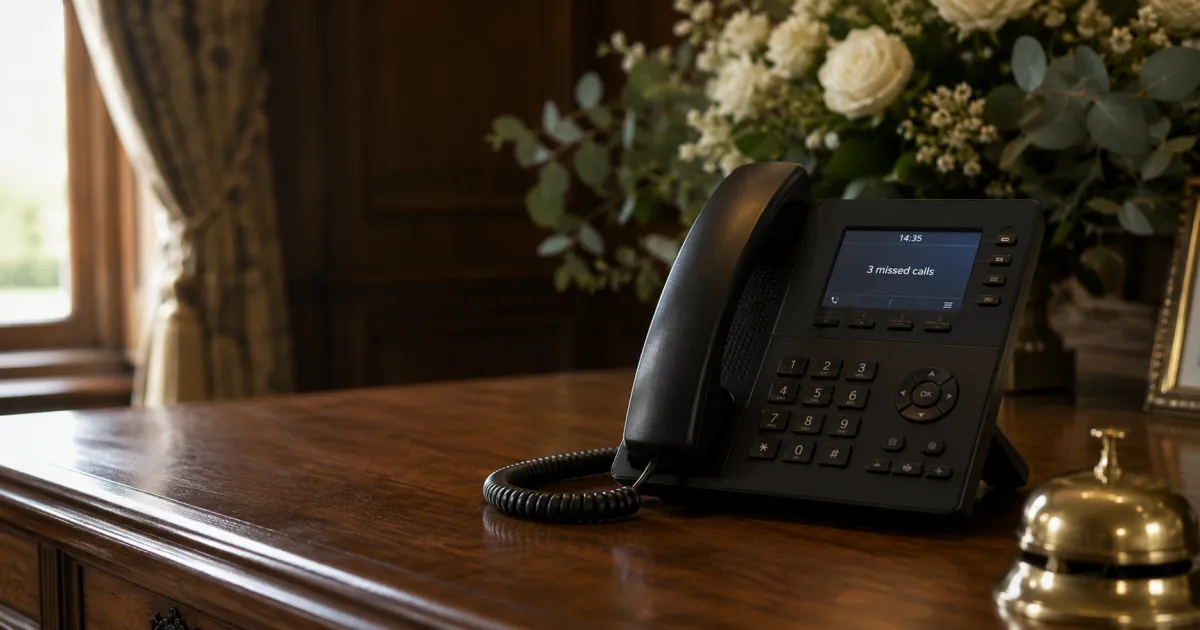
What 3 Missed Calls a Day Cost Your Wedding Venue
Three missed calls a day.
Ten percent of those callers would have eventually booked.
Average UK wedding booking value: £7,000.
That's £63,000 a month walking past your venue and into someone else's diary.
Let me say that again. Sixty-three thousand pounds. A month. From three missed calls a day.
I'm Mark from GoEngage — and our dedicated platform for venues, VenueBot. In this article, I'm going to show you why missed calls are quietly the biggest leak in most wedding venues, why voicemail won't save you, and what's now possible thanks to a category of technology that genuinely didn't exist twelve months ago.
Most venues massively underestimate how many calls they miss
Industry data on missed calls is brutal.
Across UK small businesses, somewhere between 25 and 60 percent of inbound calls go unanswered, depending on staffing and time of day.
Wedding planners specifically miss 23 percent of calls on average, according to WeddingWire research.
During peak times (lunch breaks, early evenings) miss rates climb to 40 percent.
Those peak times matter. Couples plan in their own time. Lunch hours, after work, weekends. The exact windows when most venue offices are unstaffed or running tours.
So when a venue tells me "we don't really miss many calls," what they usually mean is:
We don't see the ones we miss.
The phone rings out. Goes to voicemail. The venue never hears about the enquiry that almost happened.
The voicemail myth
Most venues comfort themselves with the same idea: if a couple really wants to enquire, they'll leave a voicemail. We'll call back tomorrow. Problem solved.
That's not what happens.
- 80 percent of callers who reach voicemail hang up without leaving a message
- 67 percent of callers to wedding vendors specifically won't leave a voicemail
- 85 percent of people whose calls aren't answered never call back at all
- 82 percent say they'll just call a competitor instead
Read those four numbers slowly.
Out of every ten couples who phone your venue and don't get through, fewer than two leave a voicemail. Of those, fewer than two pick up when you call back.
The rest are gone. Usually to whichever venue answered the phone next.
That's not a follow-up problem. That's a lost-revenue problem.
What three missed calls a day actually costs
Let's do the maths properly.
The conservative model. One missed call a day. Five percent conversion (well below the wedding industry average). Average booking value of £5,000 (the low end for UK venues).
| Variable | Value |
|---|---|
| Missed calls per month | 30 |
| Conversion rate | 5% |
| Average booking value | £5,000 |
| Lost revenue per month | £7,500 |
| Lost revenue per year | £90,000 |
The realistic model. Three missed calls a day. Ten percent conversion (closer to the top-performer average). Average booking value of £7,000 (around the UK midpoint).
| Variable | Value |
|---|---|
| Missed calls per month | 90 |
| Conversion rate | 10% |
| Average booking value | £7,000 |
| Lost revenue per month | £63,000 |
| Lost revenue per year | £756,000 |
Even on the conservative model, that's £90,000 a year on missed calls alone.
On the realistic model, it's three quarters of a million.
The revenue isn't disappearing. It's moving. Couples whose calls don't connect call the next venue on their list. That venue books the wedding. You don't.
Why hiring a receptionist isn't the answer
The instinct, once a venue owner sees those numbers, is to hire someone. Get a real human on the phone. Problem solved.
It isn't.
A full-time UK receptionist costs £35,000 to £50,000 a year, fully loaded.
They cover 40 hours a week.
They take one call at a time.
They have 25 to 30 days off per year for holidays and sickness.
Now look at the maths.
A 40-hour week is 24 percent of a 168-hour week. So a full-time receptionist covers around a quarter of the time couples are actually calling. Most enquiries arrive outside office hours. A 9-to-5 receptionist misses the calls that drove the £63K problem in the first place.
During peak wedding-show season, one person physically can't take every call.
Hiring solves the office-hours problem badly and the out-of-hours problem not at all. It costs the price of two-thirds of an annual booking lift, and it still leaves the venue exposed at exactly the moments couples want to talk.
What Voice AI actually does
This is what's changed in the last twelve months.
A modern voice AI agent answers every inbound call to a venue. Instantly. 24 hours a day. Seven days a week.
It handles the questions couples ask first: capacity, pricing range, dates, parking, accessibility, accommodation, ceremony options.
It books tours directly into the calendar.
It sends a confirmation by SMS.
It captures the couple's name, email, wedding date, and guest count, and pushes everything to the CRM.
When the question is emotional, complicated, or specific (renegotiating a package, handling a complaint, discussing dietary requirements for a confirmed booking), it hands the call to a human with full context.
The cost is around three to six percent of a human receptionist's salary.
The coverage is 24/7.
The capacity is unlimited. It handles a hundred simultaneous calls as easily as one.
This isn't speculative. Voice AI deployments in adjacent industries (legal, healthcare, home services) are reporting payback periods of six to twelve months. Gartner expects conversational AI to take $80 billion out of customer service costs globally by the end of this year. By 2028, more than half of small businesses will have an AI receptionist of some kind.
For wedding venues specifically, where 24/7 coverage and instant response have a direct, measurable revenue impact, Voice AI isn't a future trend.
It's the next layer.
Where Voice AI fits with VenueBot
Voice AI is the missing piece in the VenueBot lead conversion system.
Convert handles every digital enquiry: webchat, SMS, social DMs, email, form fills.
Care runs the pipeline, the nurture, the rescue path.
Studio AI optimises the brochure, the website, and the messaging itself.
Voice AI now closes the last gap: the phone.
One system catches every enquiry, regardless of channel, regardless of time of day.
The £63,000 a month doesn't have to be the cost of doing business.
What to do this week
Three things.
First, audit your missed calls for the last seven days. Most phone systems will tell you. Count them. Multiply by the realistic model above. That's your monthly leak.
Second, listen back to your voicemails for the same period. How many of those callers booked? How many never replied to your callback? That's your voicemail-to-booking ratio. It's almost always lower than venues think.
Third, take the Wedding Venue Health Check. Three minutes, fifteen questions. It scores your enquiry process across response time, follow-up consistency, tour booking ease, pricing transparency, and lead management. If missed calls are part of your problem, the Health Check will flag it, and tell you what's likely to fix it.
The £63,000 a month isn't a hypothetical.
It's the gap between the venues that pick up every call and the ones that don't.
Sources and further reading
- WeddingWire missed-call research — weddingwire.com
- Bridebook UK Wedding Report 2025 — bridebook.com
- Gartner conversational AI cost research — gartner.com
- VenueBot Wedding Venue Health Check (proprietary research, n=200+ UK venues) — quiz.venuebot.io/healthcheck
Common questions
How many calls do wedding venues actually miss?
Most UK wedding venues miss between 25 and 60 percent of inbound calls depending on staffing and time of day. Wedding planners specifically miss 23 percent on average (WeddingWire), with peak miss rates of 40 percent during lunch breaks and early evenings.
What does one missed call cost a wedding venue?
On the realistic model — three missed calls a day, 10 percent conversion rate, £7,000 average UK booking — that equates to £63,000 a month in lost revenue. Even a conservative model (one missed call a day, 5 percent conversion, £5,000 booking) costs £7,500 a month.
Will couples leave a voicemail if my wedding venue doesn't answer?
80 percent of callers who reach voicemail hang up without leaving a message. 67 percent of callers to wedding vendors specifically won't leave a voicemail at all. 85 percent of people whose calls aren't answered never call back.
Is hiring a receptionist the answer to wedding venue missed calls?
Not really. A full-time UK receptionist costs £35,000–£50,000 a year, covers only 40 hours a week, takes one call at a time, and has 25–30 days off per year. Most enquiries arrive outside office hours, so a 9-to-5 receptionist still misses the calls that drove the problem.
What does Voice AI for wedding venues actually do?
A modern voice AI agent answers every inbound call instantly, 24/7. It handles common questions (capacity, pricing, dates, parking, accommodation), books tours directly into the calendar, sends SMS confirmations, and pushes the couple's details to the CRM. When the conversation gets emotional or complex, it hands the call to a human with full context. Cost is around 3 to 6 percent of a human receptionist's salary.
If you'd like to see how Voice AI would work at your venue specifically, book a 15-minute walkthrough. No pitch, no pressure. Just an honest look at how your venue could capture every call from now on.
If you found this useful, share it with a venue owner who's still relying on voicemail. They'll thank you.