
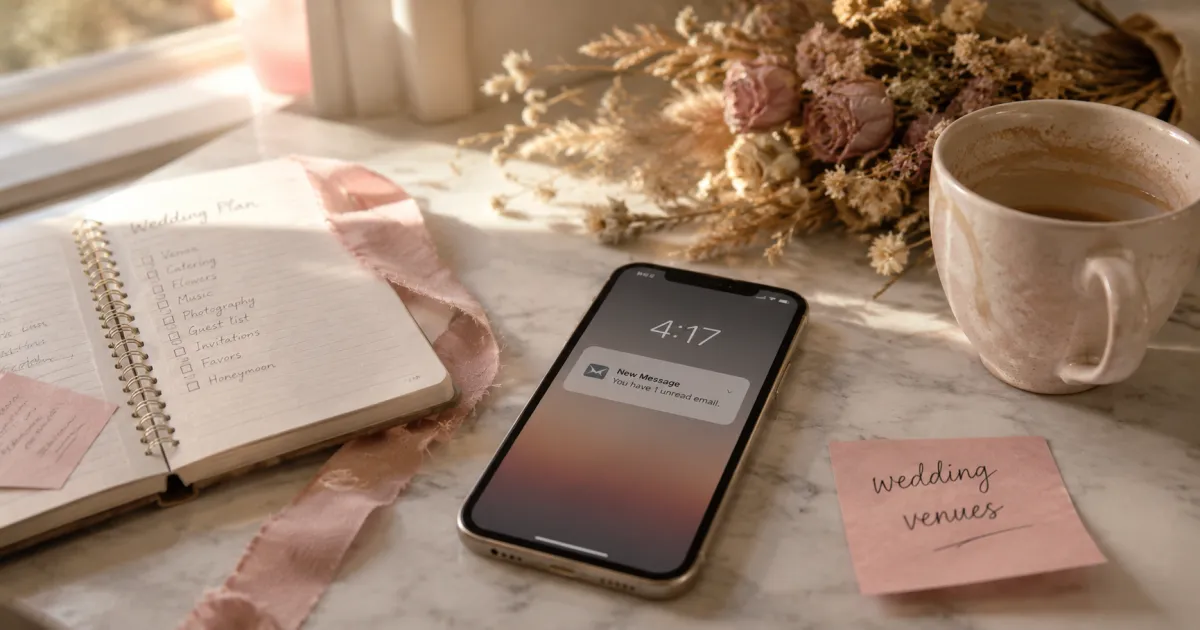
The Ghost Lead Problem: Why Couples Go Quiet (And How to Win Them Back)
A couple enquires.
You reply.
They never write back.
Most venues treat this as rejection. Almost always, it isn't.
Our own VenueBot Health Check data shows 64 percent of UK wedding venues experience ghosting from over 40 percent of their enquiries. The problem is universal. The reason it persists is that most venues' follow-up is far too short to recover the leads that go quiet.
I'm Mark from GoEngage — and our dedicated platform for venues, VenueBot. In this article I'll walk through why couples actually go quiet, why most follow-up is too short, and the structure that recovers leads months after the original enquiry.
Why couples actually go quiet
Four real reasons.
They're busy. Work, family, life. Wedding planning is one of many things on the list. The "I'll reply tomorrow" turns into next week, then next month.
They've enquired with 5 to 10 venues. Bridebook research shows couples enquire with 4 to 10 venues on average. By the time five venues reply, the inbox is chaos and the couple can't remember which is which.
They have a question they're embarrassed to ask. "Is this venue actually within our budget?" "Are we too small a wedding for this place?" "Will the parents hate it?" Couples often go quiet because they want to ask but don't want to seem rude.
Your reply didn't move them. It was a generic "thanks for your enquiry, I've attached our brochure, let me know if you have any questions." Nothing about their date, their guest count, their style. Nothing memorable. So they didn't reply.
The point: ghosting almost never means "I've decided against your venue."
It usually means "life happened, the inbox is overwhelming, and your reply didn't give me a reason to write back."
That's a recoverable position. Most venues just don't try long enough to recover it.
What "rejection" really looks like
Industry data tells a different story from what venues assume.
78 percent of couples book their venue within 4 weeks of enquiring (Bridebook). So if a couple has been quiet for 4 weeks, the booking window is closing.
But here's the part that matters: most "lost" leads aren't lost. They're just not actively planning.
Couples often pause for life events. A house move. A holiday. A family illness. A change of date. A reset on the budget after talking to parents.
In our own data, leads who haven't replied in 30 days are still recoverable. Leads at 60 days are recoverable with the right re-engagement. Even at 90 days, a meaningful share will respond if the message is right.
The window for recovery is much wider than most venues realise.
Why most venue follow-up is too short
The industry baseline is 3 to 5 emails over 14 days.
That's it. That's the standard.
After 14 days, most venues stop following up. The lead is marked "no response" and quietly moves to the back of the pipeline, where it dies.
But 78 percent of couples take up to 4 weeks to book. And the ones who don't book in 4 weeks often book in 8, 12, or 16 weeks.
A 14-day follow-up sequence catches the couples who were going to book quickly anyway. It misses everyone else.
The venues converting at 1-in-8 (versus the 1-in-30 average) aren't running 14-day sequences. They're running 50 to 90 days of structured follow-up across email and SMS.
The economics work. A 5 percent recovery rate on a £7,000 booking pays for the system many times over.
The 8 jobs a real nurture system does
Most venues think of follow-up as "checking in." That's why most follow-up doesn't work.
A real nurture system does eight specific jobs across the sequence. Each job appears multiple times. Different touches do different things.
1. Orientation and expectation-setting. Confirm receipt. Set expectations on response. Send the brochure. Make the couple feel looked after immediately.
2. Authority and expertise. Position the venue as a guide, not just a room for hire. Meet-the-team content. Planning timelines. Budget guidance.
3. Social proof and reassurance. Testimonials. Real wedding case studies. Awards. Press mentions.
4. Education and planning support. Thematic tips on guest flow, timeline mistakes, weather backup plans, what to ask on a tour.
5. Engagement and interaction. "Hit reply and tell me what you're imagining." Micro-surveys. Preference check-ins. Real conversation, not broadcast.
6. Scarcity and decision support. Popular dates. Hold mechanism. Comparison checklist. Ethical urgency, not pressure.
7. Re-engagement and recovery. Low-pressure check-ins for couples who've gone quiet. New dates released. Open day invites.
8. Post-decision reinforcement. Once they book, welcome the couple, set up future referrals, prep them for the planning journey.
Most venues do two or three of those jobs. The system VenueBot Studio AI builds covers all eight, across 26 touches, over 50 days.
Multi-channel matters more than most venues realise
Email alone misses too many couples.
Inbox overload, spam folders, mobile previews that hide context. Email open rates for venue follow-up sit around 20 percent at best.
SMS open rates are around 98 percent within 90 seconds.
The right structure is email plus SMS, used at the right moments.
SMS for: - Instant acknowledgement (within minutes of enquiry) - Tour reminders (24 to 48 hours before) - Day-before tour confirmation - Low-pressure check-ins ("any questions?") - Quick re-engagement ("did you know we're dog-friendly?")
Email for: - Long-form value (real weddings, planning tips) - Brochure delivery - Case studies and testimonials - Decision support content (deposit, hold mechanism, comparison checklists) - Education
A typical Studio AI sequence blends 20 emails and 6 SMS across the 50 days. Each channel doing the job it's best at.
When to stop (and when not to)
Three rules.
90 days of total silence: move to long-term nurture, not "lost." The couple isn't gone. They're paused. Drop them into a slow-burn quarterly cadence rather than deleting the record.
New season, new dates, new package: trigger reactivation. "We've just released our 2027 dates" or "We've added a new ceremony space" is a legitimate reason to re-engage. Couples who went quiet often respond to news, not chase emails.
Never delete the lead. Reactivation campaigns recover 5 to 15 percent of dormant leads even months after the original enquiry. The cost of keeping a lead in the system is zero. The opportunity cost of deleting it is the lifetime value of a couple who would have come back.
The venues running 1-in-8 conversion all have one thing in common.
They don't write off ghosted leads. They build systems that come back to them.
How VenueBot Studio AI builds your sequence
Studio AI's Nurture Sequence Analyser and Builder generates a complete 26-touch sequence in under three minutes.
Personalised to your venue's brand voice. Personalised to your spaces, accommodation, and ideal couple. Built on 60+ published research sources (Bridebook, Hitched, WedPro, The Venue Expert, HubSpot, Salesforce, Harvard Business Review, plus analysis of 10,000 real venue enquiry journeys).
The output is CRM-ready templates — emails and SMS messages with merge fields, dropped straight into your automation system. Not concepts. Actual sequence copy ready to send.
Studio AI also has an Audit mode for venues that already have a follow-up sequence. It scores every existing message against a research-backed rubric, gives each one a green or amber dot across multiple dimensions, and a "Rewrite ready" button that improves the message in your venue's voice.
No one else in this industry does this. We checked.
What to do this week
Three things.
First, count the touches in your current follow-up sequence. If it's fewer than 10, you're losing recoverable leads. The industry baseline of 3 to 5 emails isn't enough.
Second, audit your "lost lead" pile. Pull a list of couples who haven't replied in 60+ days. How many have you written off without a single re-engagement attempt? That's your recovery opportunity.
Third, take the Wedding Venue Health Check. Three minutes, fifteen questions. It scores your follow-up consistency alongside response time, pricing transparency, tour booking, and lead management. The output flags exactly where ghosted leads are leaking.
Couples don't ghost because they don't like you.
They ghost because no one followed up well enough or long enough.
Sources and further reading
- Bridebook UK Wedding Report 2025 — bridebook.com
- Hitched National Wedding Survey — hitched.co.uk
- WedPro CRM industry research — getwedpro.com
- Harvard Business Review on consumer decision-making — hbr.org
- HubSpot marketing science research — hubspot.com/research
- Salesforce nurture frameworks — salesforce.com
- VenueBot Wedding Venue Health Check (proprietary research, n=200+ UK venues) — quiz.venuebot.io/healthcheck
Common questions
Why do couples go quiet after enquiring with a wedding venue?
Four real reasons: they're busy, they've enquired with 5 to 10 venues and the inbox is chaos, they have a question they're embarrassed to ask, or your reply was too generic to give them a reason to write back. Ghosting almost never means "I've decided against your venue" — it usually means life happened.
Are ghosted wedding venue leads actually lost?
Most aren't. Couples often pause for life events — house moves, holidays, family illness, budget resets. Leads who haven't replied in 30 days are still recoverable. Leads at 60 days are recoverable with the right re-engagement. Even at 90 days, a meaningful share will respond if the message is right.
How long should a wedding venue follow-up sequence be?
The industry baseline of 3 to 5 emails over 14 days isn't enough. 78 percent of couples book within 4 weeks of enquiring (Bridebook), but the ones who don't book in 4 weeks often book in 8, 12, or 16 weeks. Top-performing venues run 50 to 90 days of structured follow-up across email and SMS.
What jobs does a real nurture sequence need to do?
Eight specific jobs across the sequence: orientation and expectation-setting, authority and expertise, social proof and reassurance, education and planning support, engagement and interaction, scarcity and decision support, re-engagement and recovery, and post-decision reinforcement. Most venues only cover two or three of these.
If you'd like to see Studio AI generate your venue's specific 26-touch sequence in real time, book a 15-minute walkthrough. We'll build it on the call.
If this was useful, share it with a venue owner who's writing off too many leads. They'll thank you.